skip to main |
skip to sidebar
A few days ago, the investigative panel was finalized for the bipartisan committee charged with investigating the causes of the financial collapse. Expectations are high. The new panel has already been compared to the Senate subcommittee that investigated the 1929 crash. That celebrated investigative body, known as the Pecora Committee after its magnetic investigating attorney, exposed all kinds of legal, but damned sneaky, goings-on and gettings-up-to on Wall Street.
Is our new commission, composed mainly of politicians and chaired by *choke* the former Treasurer of California (Phil Angelides), up to the job? Can a panel with only two people who know anything about derivatives (Brooksley Born and Heather Murren) really untangle what happened to AIG? Can a committee that features Bill Thomas twice voted meanest Senator in Washington ever agree on anything?
The answer, in my opinion, is that it doesn't matter. The much-lauded Pecora Committee wasn't a serious investigation - it was a circus (complete with little people). It was representative democrary in action: the subcommittee, chaired by a guy who was born in a "dug out" in the Dakota Territory, allowed representative ordinary people a forum to humiliate Wall Street bankers.
The '33 Act and the '34 Act were written by legal scholars, but the scholars got the opportuntity to write the law they wanted because the Pecora Committee kept Wall Street notorious. A string of headlines about bank presidents not paying taxes, or giving out plum stock offerings for free to their pals, kept people mad enough to support the strong regulation that resulted.
We need better reform than has been proposed by the administration. The new commission can help us get there by keeping up the parade of shifty bankers and little old ladies who've lost everything.
Matt Taibbi’s article about Goldman Sachs is a refreshing return to form for Rolling Stone, the magazine that was once home to Hunter S. Thompson. Gonzo journalism, a term coined by Thompson when he worked for Rolling Stone, is a journalistic form that puts a cantankerous writer and his sainted opinions right at the center of the story. If you ask me, the way we talk about the financial crisis could benefit from this kind of humanizing touch. Taibbi is pissed off. Aren’t you?
Since the article came out, Taibbi has spent much of his time defending himself. He’s been called sloppy (Business Insider), dumb (Megan McCardle), and intemperate (Felix Salmon to be fair, Salmon likes the article).
His critics are at a disadvantage – Taibbi is cooler than they are and he writes better. Megan McCardle takes an unfortunate stab at sounding hep and titles her article “Matt Taibbi Gets His Sarah Palin On.“ The Business Insider is shocked to find it isn’t reading the Economist: “The story is really not meant,” they sniff, “for an audience interested in a discussion of financial markets, as evidenced by his rhetorical style.” I laugh every time I read that.
This morning, I want to wander a bit from securities regulation and talk about something close to my heart: libraries. The ecomony is being cited as the reason law firm libraries are cutting their print collections. One very senior law librarian I spoke to predicted the demise of physical library space in law firms. I find this thought personally and professionally depressing, and I think it may be too late to stop it. I have the feeling this is a bit like blaming the economy when you fire the maid who broke your mother's gravy boat.
A decade ago, when times were good, law firm administrators (whom I shall refer to as "beancounters") needed space to build more lawyer offices. They cast their jaded eyes upon the library. "Isn't everything online, now?" They wheedled. "Why do we need so many books?" Librarians and (more importantly) a few research-saavy partners stood up for the books. Print collections were cut and law firm libraries got smaller, but they didn't go away.
But, the beancounters didn't forget - the elimination of the library is still on their minds and now our economic woes have shifted the advantage their way. Shrinking or eliminating the library's footprint is no longer a way to grow the business - it is a way to survive. The research-saavy few can't hold out anymore against the reverse-luddite beancounters. Because, lets be clear, everything is not online and books often contain finding aids which haven't been, or can't be duplicated electronically.
Can the beancounters be stopped? Any ideas?
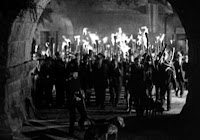 If you're going to be in Charlotte on April 29th, the most entertaining show in town will be at the Belk Theater - Bank of America's annual meeting. The price of admission is only $8.73 (that's BofA's share price as of this moment). There are 11 items on the agenda including two competing say-on-pay proposals (via Corporate Counsel blog).
It has been a long road to the final proxy. BofA has been the subject of at least ten no-action letters regarding shareholder proposals. Bad management decisions (cf Merrill Lynch) left BofA shareholders pretty ticked. It looked like the wind was behind a bunch of governance proposals (like the separation of chair and CEO: via Race to the Bottom) that usually get shut out of the party and end up hanging around outside trying to look tough. But, as has happended so frequently during this crisis, opposition appears to be crystallizing around personality instead of process.
Ken Lewis probably needs to go, but let's not take our eye off the ball (again) - this crisis won't get solved with pitchforks and flaming torches.
If you can't be in Charlotte, BofA reminds you that "you may listen to a live audiocast of the meeting on our website at http://investor.bankofamerica.com at 10:00 a.m., local time, on April 29, 2009."
 Yesterday, I was reading "The Great Crash," by John Kenneth Galbraith, and I was struck that in 1929 and in the present crash the crisis was exacerbated by a seemingly arbitrary decision to let a large financial institution collapse.
Bank of United States was founded on the Lower East Side of Manhattan in 1913 (in a building that now houses Winda Restaurant Supplies and White Slab Palace). By 1930 it was one of the largest banks in New York, but it had passed from the capable hands of its founder Joseph Marcus to his differently-abled son, Bernard. The younger Marcus sold equity in the bank. The shares came with an ironclad guarantee: the bank would buy them back at the issue price of $200. In 1930, when the shares were trading at $90, a shareholder went into a branch in the Bronx and asked the bank to buy back her shares. They tried to talk her out of it. When she came back the next day, she came with friends who also had shares to sell. Thus began the first post-1929 bank run.
Even though the New York Superintendent of Banks thought "management was on an extremely dangerous and probably illegal course of action" (Trescott, The Failure of the Bank of United States, 1930; Journal of Money, Credit, and Banking, August 1992, 384). He asked J. Herbert Case, president of the New York Fed, to step in and rescue the bank. Case proposed a plan to merge Bank of United States with three other large banks, but during a late night meeting on December 8th, the plan fell apart (Proposal to Merge Four Banks Abandonded, New York Times, 12/9/30).
Bank of United States failed on the 11th. At the time, it was the largest bank failure in US history. "The demise of this bank worsened the panic. As deposits were withdrawn, banks contracted credit, driving the economy deeper into recession." (Glasner and Cooley, Business Cycles and Depressions: An Encyclopedia, Taylor & Francis, 1997) The failure of Bank of United States made depoistors across the country fear for their savings. As John Steele Gordon put it: "Wall Street refused to help a bank it could have saved. That touched off a wildfire of failure throughout America."
The Wall Street Journal called the downfall of Lehman Brothers "largely of its own making. The firm bet heavily on investments in overheated real-estate markets," but, the Journal adds, "Lehman's bankruptcy ... proved far more destabilizing ... than many had expected." Many, but not everyone - the French Minister of Finance Christine Legard warned Henry Paulson not to let Lehman fail.
The government's decision to allow Lehman to collapse made other investment banks appear vulnerable. The Wall Street Journal called it "a turning point in the way investors assess risk."
For more on Bank of United States see the entry in Wikipedia (it really is good).
The administration has issued draft legislation granting the power to seize and unwind financial institutions deemed too big to fail. Why wasn't the proposed bill also introduced in Congress? Are they testing the waters, or could they not find a sponsor?
People are understandably annoyed at AIG. Their conversion of bailout money into a personal windfall was ... surprising. Guest poster Mark Schwartz (our first!) argues that we can't understand the behavior of AIG executives because they inhabit a different reality.
-----------------------------------------------------------------------------The past several decades have seen a massive transfer of wealth from shareholders and rank and file employees to senior level executives. This shift has placed normal people and corporate managers in parallel realities. Like the Bourbons at Versailles, executives seem incapable of understanding what the little people are so exercised about. This problem didn’t start with AIG, or even the financial sector generally. By creating an expectation of kleptocrat-level compensation, the twin instrumentalities of bonuses and stock options shifted the frame of reference in the executive suite. Stock options were supposed to be the ultimate way to tie performance to compensation, but when performance lagged, ways were found (backdating, resets) to make sure pay did not.
So these days, when a company files for bankruptcy, immediately after voiding union contracts, executives award themselves retention bonuses. Retention bonuses for the structured finance group at AIG? When Nick Leeson lost seven billion dollars of Barings' money he got no bonus. He got prosecuted.
Adding further fuel to the fire, senior government regulators either grew up within this system or are so besotted by the larger-than-life folks they are supposed to regulate that they also seem unable to understand how this plays to the public. It is not that government officials knew about these AIG bonuses but rather, that they were caught off guard by the visceral fury of the American public. How, other than by drinking the Kool-Aid themselves, could they be surprised?
So far, Obama's appointees (And I like him very much) don’t seem to be breaking the pattern. Was Mary Shapiro's tenure at FINRA so stellar that she should head the SEC? Why not Andrew Cuomo? The only one I trust is Sheila Bair. She at least has her heart in the right place.
Although you, astute researcher, have probably noticed, it has just come to my attention that I'm not doing regulatory research the way I used to. You don't see many proposed rules in the Federal Register these days (or the Federal Reserve Bulletin, for that matter). Instead, this year's most important rules are being issued as press releases. As far as I can tell, the only place where one may find all the rules, agreements and guidelines governing stimulus spending is the web.
The Department of the Treasury has a very good links page, but some of the important documents are on the websites of other government entities like the New York Fed. The administration has put up two websites: recovery.gov, which is low on legal content, and financialstability.gov which is "coming soon."
These press release "rules" convey only general concepts. They arise in a vacuum - without visible discussion and free of the editorial explanations that accompany real rules. To me, this is a serious blow to the authority of the rules and to the notion of government transparency generally.
Reading gets only one day, while "quality" rates a whole month (HJ Res. 204, 135 Cong. Rec S11716-03, 1989 WL 191904) and libraries, apparently, fall somewhere in between.
In honor of National Library Week, The Speculative Debauch will present a research skills webinar titled "How to Keep on Top of the Financial Crisis Instead of the Other Way Around."
Email invitations will be sent soon. If you don't get one please drop me an email and let me know.
 I didn't understand the psychology of bank CEO's who destroyed storied institutions by turning all their capital into risky securities until I played Monopoly with my four-year-old daughter. My daughter loves Monopoly, and even though she doesn't really understand it she usually wins. That's because after about half an hour, she gets bored and wants to stop. We add up the money and property and she often has the most. In our last game she tried a new strategy - she didn't buy anything. She still won. If you play for the very short term, Monopoly is essentially a game of chance. Whether you win depends entirely on when you stop. Finally, as my wife observed, if you play (markets, monopoly) for the short-term, you're not invested in the future - not committed to preserving anything, doing what's best to keep the institution going, etc.
 To lighten the mood a little, let's talk about toxic waste. I'm reading a book about organized crime in southern Italy - Gomorrah, by Roberto Saviano. Saviano recounts the astonishing inventiveness of the illegal waste disposal industry based outside Naples. They bring toxins from all over Europe and dump them into any available space.
When the dumps fill up, they set a fire. When there's nothing left to burn, they cover everything and build houses. The houses must be built on concrete supports because the trash heaps are unstable. Another profitable tactic is mixing the waste with something else. For instance, it can be combined with compost and sold to farmers or mixed into cement and made into walls. In the end, a toner cartridge from Milan rains down on Capri, donates a few toxic grains to a bottle of Chianti and has something left to make a hotel in Rome carcinogenic.
Sounds sort of like what we did with subprime mortgages, doesn't it? One bad mortgage was packaged, borrowed against, insured and re-packaged until little bits of it were incorporated into every aspect of our financial system. Instead of making the toxins disappear, it made everything it touched a little more toxic.
The weird thing is, in southern Italy, just like in our banking sector, the bosses dumped most of the waste right near their houses. Saviano has a theory about why and maybe it applies with equal force to our investment bankers, "The bosses have no qualms about saturating their towns with toxins ... The life of a boss is short. In the here and now of business there are no negatives, only a high profit margin."


